
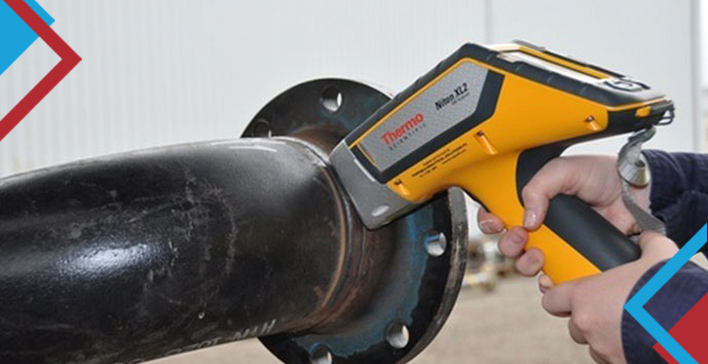
Positive Material Identification
Positive Material Identification (PMI) is the analysis of a material, this can be any material but is generally used for the analysis of metallic alloy to establish composition by reading the quantities by percentage of its constituent elements. Typical methods for PMI include X-ray fluorescence (XRF) and Optical Emission Spectroscopy (OES)
PMI is a portable method of analysis and can be used in the field of components. X-ray fluorescence (XRF) PMI cannot detect small elements such as carbon. This means that when undertaking analysis of stainless steels such as grades 304 and 316 the low carbon 'L' variant cannot be determined. This however can be analyzed with Optical Emission Spectrometry (OES).
Advantages of PMI Testing
Versatility and Consistency
PMI testing with XRF Analyzers offers versatility across all component sizes and shapes, providing consistent and repeatable results for quick material analyses in diverse environments. It is a valuable tool in situations where material composition is unknown, documentation is missing, or samples cannot be removed for routine testing. The Smart OES portable chemical analyzer, such as the Hitachi PMI Master, utilizes Optical Emission Spectroscopy to accurately determine alloy compositions through plasma burns and elemental wavelength measurements.