Eddy Current Testing
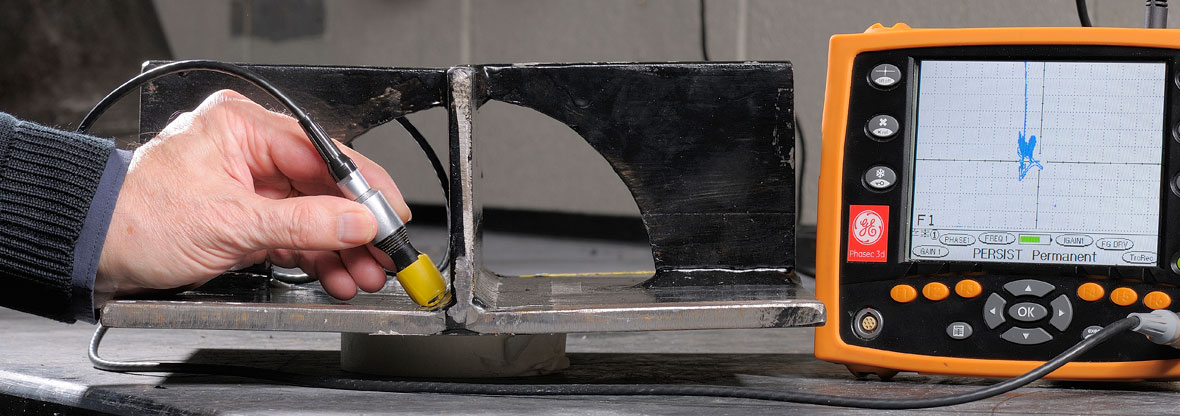
In eddy current testing, a coil carrying an AC current is placed close to the specimen surface, or around the specimen. The current in the coil generates circulating eddy currents in the specimen close to the surface and these in turn affect the current in the coil by mutual induction. Flaws and material variations in the specimen affect the strength of the eddy currents.
The presence of flaws etc is therefore measured by electrical changes in the exciting coil. Both voltage and phase changes can be measured, but some simpler instruments measure only the voltage changes.
The strength of the eddy currents produced depends on the:
1. electrical conductivity of the specimen;
2. magnetic permeability (for a ferromagnetic specimen);
3. stand-off distance between the specimen and coil;
4. AC frequency used in the exciting coil;
5. dimensions of the coil and specimen;
as well as the presence of flaws, and much of the success of eddy current testing depends on separating the effects of these variables. Most eddy current instruments require calibration on a set of test specimens and the flaw sensitivity can be very high.
TUBE INSPECTION EDDY CURRENT
Eddy current testing of tubes is an effective way of assessing the condition and lifespan of tubes, particularly in the power generation, petrochemical, chemical, fertilizer, and air conditioning industries. The technique is applied to detect corrosion, pitting, cracks, erosion, and other changes to both the tube's interior and exterior surfaces.
It is a high-speed inspection technology, and one of its primary benefits is that it can be used on paint and coatings. The process is only applicable to nonferrous materials like stainless steel, copper, and titanium. We also conduct remote field and magnetic biased eddy current tests on carbon tubing.
Pulsed Eddy Current
Pulsed Eddy Current testing and inspection give essential information on the actual status of your assets, allowing you to monitor and manage any production or safety issues more quickly and easily than previously. Insulation materials do not need to be removed, and surfaces do not require any special preparation, lowering overall and underwater inspection expenses dramatically. In general, PEC services require substantially less time than conventional methods, allowing for quick and convenient in-operation testing and inspection with no disruption of output.
Pulsed Eddy Current readings taken repeatedly at the same spot can be accurately duplicated, regardless of casing, coatings, or insulation. PEC technology yields data with a plus/minus 10% accuracy for corrosion detection and a plus/minus 0.2% accuracy rate for corrosion mapping.
Remote Field Electromagnetic Testing (RFET)
This method is typically used on ferromagnetic tubes of heat ex-changers and boilers and to effectively measure loss of wall thickness. A probe comprising a single or multiple transmission coils are positioned at twice the distance of the pipe diameter from the reception coil and uses a direct transmission mode allowing for detection of internal and external flaws. At Green Technology we specialize in providing best inspection services for magnetic heat exchanger tubes and boiler tubes having complex geometries using customized flexible probes.
Magnetic Flux Leakage (MFL)
The Magnetic Flux Leakage analysis confirms the presence of potential flaws due to wall thickness loss caused by corrosion or surface flaws such as cracks. Magnetic sensors are strategically positioned between the magnet poles to detect the flux leakage due to presence of such discontinuities. MFL is compatible with inspection of finned tubes. Determining the condition of the component and proper reporting of the damaged area is the ultimate goal of our team.
Internal Rotary Inspection System (IRIS)
The Internal Rotating Inspection System (IRIS) uses conventional ultrasound to accurately measure the thickness and detect wall loss in a variety of tube material. With the help of a rotating turbine in coupling water, it ensures a complete 360 degree coverage for the entire length of the tube.
Basic Advantages
1. ECT is significantly more sensitive than PT for detection of tight cracks, e.g. Cl-SCC in austenitic
stainless steels
2. ECT can inspect through paint coatings
3. For inspection of small areas, ECT is much faster. PT is slow because of the long dwell times.
Green Technology Private Limited engages its team at the request of customer or when inspection results warrant the need for additional prove-up type information.